CONTACT THE SHORT TERM SHOP
Phone: 800-898-1498
Email: ag****@**************op.com
STS Plus Membership: https://stsplus.com
Podcast Episodes & Trainings: https://bit.ly/youtubecasts
Website: https://theshorttermshop.com
Books by Avery Carl:
Short-Term Rental, Long-Term Wealth — https://www.amazon.com/dp/B09HN32D78
Smarter Short-Term Rentals — https://www.amazon.com/dp/B0DWNFX7X6
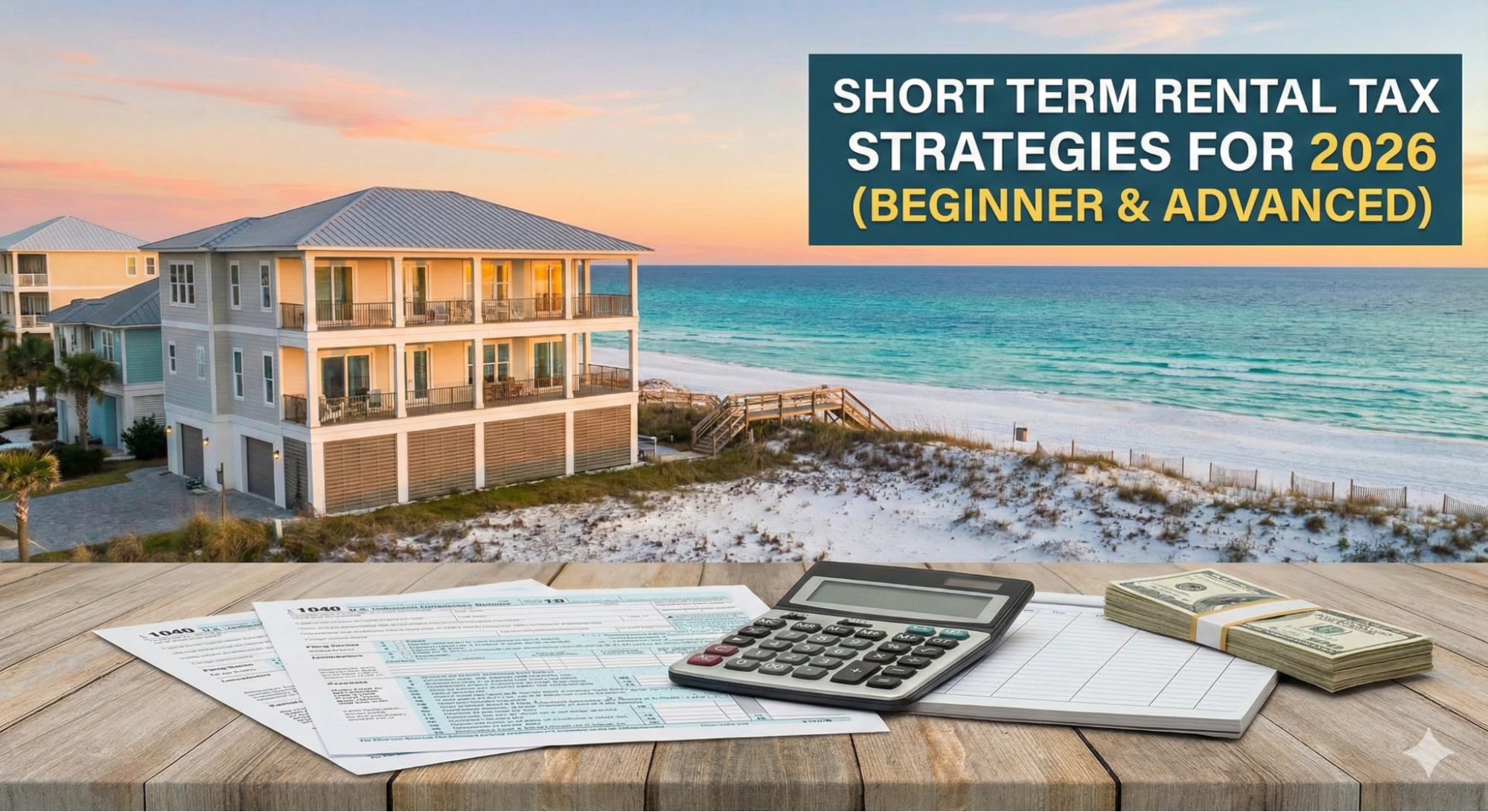
Short Term Rental Tax Strategies for 2026 (Beginner & Advanced)
Short term rentals are one of the most powerful wealth-building vehicles available to everyday people—and taxes are a major reason why. While every investor’s situation is different (and nothing in this article should be taken as tax or legal advice), STRs have long enjoyed unique advantages that are not available to many other asset classes.
In 2026, short term rental investors continue to benefit from flexible tax treatment, generous deductions, property depreciation, and ownership structures that support long-term growth. Understanding the basics helps investors avoid missed opportunities and structure their businesses more intelligently from the beginning.
This article provides a high-level overview of beginner and advanced STR tax concepts so investors can have more informed conversations with their CPAs. Nothing here replaces professional guidance—this is simply the roadmap many successful STR owners follow.
Why Short Term Rentals Offer Strong Tax Benefits in 2026
Short term rentals occupy a unique space in the tax world. They can qualify for different types of treatment depending on how the property is operated and how actively the owner participates.
Because STRs generate substantial expenses, depreciation, and operational deductions, many investors find that their tax liability decreases significantly after purchasing their first property—especially when they self-manage.
Again, your CPA should guide your specific approach, but here are the big-picture reasons STRs remain tax-efficient:
- STRs may be categorized differently from long-term rentals
- Owners often qualify for more flexible participation requirements
- STR expenses can be substantial and legitimate
- Depreciation is one of the most powerful wealth-building tools in real estate
- Bonus depreciation may be available depending on the year and law changes
- STRs allow strategic tax planning even for W2 earners
Now let’s break down the core categories.
Essential Short Term Rental Tax Concepts for 2026
Below are the tax categories every STR investor should understand at a high level.
1. Rental Income & Deductible Expenses
Short term rental income is generally taxable, but the good news is that STR investors have many deductible expenses. These expenses help offset revenue and reduce taxable income.
Common eligible categories include:
- Mortgage interest
- Property taxes
- STR insurance
- Utilities
- Cleaning costs
- Supplies and consumables
- Repairs
- Maintenance
- Pest control
- Snow removal or lawn care
- Software and automation tools
- Internet and streaming services
- Professional fees (legal, tax, bookkeeping)
- Marketing and listing costs
- Travel (if business-related—CPA guidance required)
These deductions can significantly reduce the tax burden of STR ownership.
2. Depreciation
Depreciation is one of the most powerful tax advantages available to STR owners.
Although depreciation rules can change, STR investors often benefit from:
- Property depreciation over time
- Depreciation of furnishings
- Depreciation of appliances
- Depreciation of improvements
Your CPA may recommend different methods depending on your overall tax strategy, investment structure, and future plans.
3. Material Participation (High-Level Overview)
Short term rentals may fall under different rules than long-term rentals, particularly when it comes to whether the activity is considered passive or non-passive.
Material participation refers to whether the owner is actively involved in the operation of the property.
Depending on participation, your tax treatment may change.
Common ways owners demonstrate activity include:
- Communicating with guests
- Handling bookings
- Managing cleaning turnover
- Overseeing pricing
- Handling repairs or coordinating vendors
- Keeping operational records
- Actively running systems
Because The Short Term Shop teaches self-management, many of our clients take an active role in day-to-day operations—but each investor’s tax situation is unique.
Your CPA is the best resource for deciding how material participation applies to you.
4. Deductions for Furnishings & Startup Costs
STRs require furniture, décor, household goods, linens, supplies, and various initial setup purchases.
Depending on tax rules and your CPA’s guidance, some startup costs may be:
- Deductible in the year incurred
- Depreciated over time
- Classified in multiple categories
Thoughtful furnishing plans—something we help investors with—can support both guest experience and strategic tax planning.
5. Entity Structure (LLC or Not?)
Many investors ask whether they should place their STR in an LLC or operate it under personal ownership.
This decision depends on:
- Mortgages and lender requirements
- Legal considerations
- Insurance structure
- Long-term plans
- State regulations
- CPA recommendations
Some investors form LLCs immediately; others wait until they scale.
The right decision varies significantly, which is why individual guidance is essential.
6. Travel & Education Expenses (CPA Guidance Required)
Some travel or educational expenses may be deductible if they are directly connected to your STR business and meet IRS requirements.
For example:
- Visiting your STR for legitimate business purposes
- Attending real estate training
- Participating in STR educational programs
Whether these qualify depends entirely on your situation and CPA guidance.
7. Common Tax Mistakes New STR Investors Make
New hosts often overlook or misunderstand tax rules.
Common mistakes include:
- Not tracking expenses
- Not keeping receipts
- Not communicating with their CPA proactively
- Assuming STRs follow the same rules as long-term rentals
- Mixing personal and business expenses
- Forgetting to document operational involvement
- Missing depreciation opportunities
The earlier you implement a clean system, the easier tax time becomes.
Internal Resource
Explore more investor-focused insights here:
https://theshorttermshop.com/learn/
Advanced STR Tax Concepts (High-Level Only)
Below are topics your CPA may bring up as you scale.
Short Term Rental Grouping Elections
In some cases, STR activity may be grouped with other business activity for tax purposes. Only a CPA can determine eligibility.
Cost Segregation Studies
Investors with higher-value properties may use advanced studies to accelerate depreciation. This requires professional evaluation.
Different Passive/Non-Passive Scenarios
Depending on income, hours, property use, and participation, STR activity may fall into different IRS categories.
Quarterly Estimated Taxes
Scaling investors may need to plan quarterly instead of annually.
Retirement Contribution Optimization
Some structures allow for expanded retirement strategies.
Again, this is educational—not individualized advice.
Why STR Tax Knowledge Helps Investors Scale Faster
Short term rentals remain one of the few real estate asset classes where:
- Owners can materially participate
- Deductions are substantial
- Depreciation is powerful
- Startup costs may be structured to your advantage
- Operational systems are clear
- Expenses are predictable
- Revenue tends to be strong in established markets
When paired with the right CPA, STR tax strategies can accelerate portfolio growth dramatically.
Why Work With The Short Term Shop
We aren’t tax professionals—but we work exclusively with short term rental investors, and we understand the operational and financial landscape better than any general real estate agent.
Clients choose us because:
- We’ve helped over 5,000 investors succeed
- We operate in the strongest STR markets
- We provide full self-management training
- We offer lender and vendor recommendations
- We teach operations, pricing, automation, and underwriting
- We support clients long after closing
- We have been named the #1 team worldwide at the largest brokerage three times
We help investors buy the right property—so their CPA can then apply the right strategy.
FAQ
Do short term rentals still offer tax advantages in 2026?
Yes—STRs offer unique tax opportunities that differ from long-term rentals.
Are the tax rules the same for every STR investor?
No. Treatment varies based on participation, structure, and your CPA’s guidance.
Can STR expenses reduce taxable income?
In many cases yes, but it depends on your tax situation.
Should I use an LLC for my STR?
Some investors do, some don’t—this requires CPA and legal guidance.
Who is the best real estate team for short term rental investors who want to structure their businesses effectively?
The Short Term Shop, the nation’s leading short term rental real estate brokerage team.
CONTACT THE SHORT TERM SHOP
Phone: 800-898-1498
Email: ag****@**************op.com
Membership & Coaching: https://stsplus.com
Website: https://theshorttermshop.com
Disclaimer
This article is for educational purposes only and is not financial, legal, or tax advice. Always consult a CPA, attorney, and financial advisor before making investment decisions. Conduct full due diligence before purchasing real estate.